
AI 101 · Part 7 of 7
September 1, 2026 · 6 min read
By David Crush
How tools make AI more useful
This series has been honest about what AI gets wrong. Part 4 gave you the full map: stale facts, no clock, not a calculator, thin crowds, the rigged crowd. Part 5 told you where your words go. Part 6 explained why there are so many models and why the default pick is usually fine.
Here is the good news saved for last: almost every weakness has a patch — and the patch is not a smarter model. The guesser does not get smarter. It gets handed tools.
What a tool actually is
When you chat with AI, it feels like one continuous conversation — you ask, it answers. But mid-answer, something else can happen. The model can pause, ask the app to do something, read what comes back, and only then finish the reply.
That "do something" is a tool call. The app hands the model a menu of capabilities — run a web search, open a webpage, press a calculator — and the model decides when to use one. The result comes back as fresh material the model reads before writing the rest of the answer.
The key insight, and it is worth saying plainly: the tool is not part of the model. It is an extension bolted on by the app. The model is still the guesser from Part 1. The search engine, the calculator, the page reader — those are separate pieces the app wires in. That is why the same model can be brilliant in one app and limited in another: the app decides which tools are on the menu.
You have already met one tool call, even if nobody called it that. Remember Part 4: when you ask about "today" and the app knows the date, that is the app quietly whispering today's date into the conversation before your question reaches the model. The model did not know — the app supplied it. That whisper is a primitive tool call. The full version is the model asking for something itself, mid-answer.
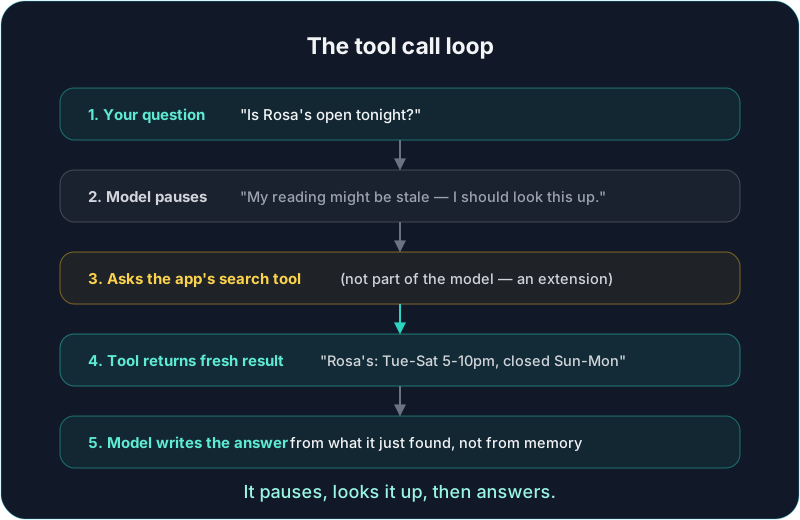
Walkthrough: the restaurant hours
Take the stale-facts example from Part 4. A restaurant changed its hours last year. The model's training reading still says the old hours — and it reports them on day 1,000 exactly as confidently as on day 1.
Ask "Is Rosa's open tonight?" without a search tool, and the model answers from memory. Maybe right, maybe a year old. Same polished voice either way.
Ask the same question with a search tool, and the flow changes. The model recognizes it does not know tonight's hours from its reading alone. It pauses. It asks the app to search — or to read Rosa's website. The tool returns what it found right now. The model reads that result and writes the answer from it.
Same model. Same guesser. The difference is entirely the tool.
The weakness-patch map
Part 4 named the weaknesses. Here is what patches each one — and you can now recognize these in the wild:
| What goes wrong | The patch |
|---|---|
| Stale facts — hours, prices, who holds an office | Web search, or reading the actual page |
| Thin-crowd topics — your town's recycling rules, a niche hobby | Reading the official page nobody wrote much about |
| No clock or calendar — "today," "this weekend" | The app supplies the date (you met this in Part 4) |
| Not a calculator — the dice from Part 4 | A real calculator tool: the model asks, the app computes, the model quotes the result. Math is computed, not guessed. |
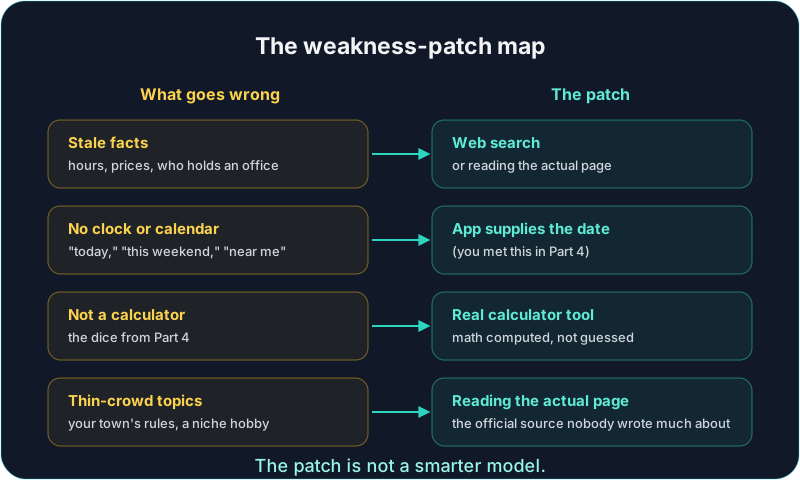
The punchline: you learned these weaknesses by name in Part 4. Now when an app says it can search the web, or when you see a calculator icon, you know exactly which gap it is trying to fill.
How to tell when it is happening
The visible signs are usually subtle but learnable:
- A status line while you wait — "Searching the web..." or similar — means a tool is running.
- Source links in the answer mean the model read something fresh and is pointing you at it.
- A pause before factual claims, especially about current events or local details, often means a lookup happened first.
And here is the empowering inverse from Part 3: if your app cannot search, you can be the tool. Paste the page. Attach the document. Hand over the real thing — that was always a manual tool call. The habit of briefing well and handing over raw material is you doing for the model what a search tool would do automatically.
What tools cannot fix
Tools patch knowledge problems — not judgment problems. Three honest limits:
The source can lie. A search tool that reads a scammy webpage repeats the scam in the same warm, trustworthy voice the model uses for everything. Part 4's rigged crowd applies to tool results too: the answer is only as good as what the tool read.
The synthesis is still guessed. A model can mangle perfectly good search results — drop a caveat, mix up two sources, smooth over a contradiction. The lookup was real; the write-up is still the guesser.
Verification habits survive — they just get easier. "Ask for the source — then open one" from Part 4 works better when sources actually exist. The habits do not go away. They become more useful.
Integrations and actions — the next rung
Where this is heading: many apps now let you connect your calendar, files, or email so the AI can do things for you — not just answer questions. "Agents" that book, buy, or send on your behalf are arriving fast.
Two calibrated notes, one line each. First: every connection is more of your words flowing through Part 5's pipes — connect deliberately, the same way you would think before pasting a tax return. Second: when AI can act, its mistakes stop being just wrong words — keep a human on the send button.
No doom, no hype. Just the two instincts worth installing before the features arrive.
The full picture
Seven parts trace back to one picture: the very good guesser.
- Part 1: What it is — a crowd of guessers, confident whether right or wrong.
- Part 2: What to hand it — tedium, thinking partner, multiplier.
- Part 3: How to brief it — vague in, average out; five habits that fix that.
- Part 4: When to doubt it — the skeptic's map, verification habits, when AI is the wrong tool.
- Part 5: What happens to your words — four copies, the nickname trick, who owns the output.
- Part 6: Which guesser to ask — decode the menu, right-size the tool, default is fine.
- Part 7: The tools that patch its limits — search, calculator, page reader, and the human who knows when to verify.
A guesser plus tools plus a human who knows its limits is genuinely powerful. And the human part — the judgment, the verification, the decision about what goes in the box — is the one nobody can bolt on.
If this series helped, send it to the person who inspired it. Everyone has someone who stopped a demo to ask "what actually is this?" That person deserves the honest version.
Ethyx is in closed testing with an access code today. Everything in this post applies to any AI chat app, not just ours. This completes the AI 101 series — all seven parts are linked from the series overview.
Send this to someone who asked what AI is.