AI 101 · Part 3 of 7
August 28, 2026 · 7 min read
By David Crush
How to ask so you get good answers
By now you know what you are talking to — a very good guesser — and what it is for. This part is the skill that makes both of those pay off: how to ask.
Here is the good news up front: there are no magic words. No secret phrases, no special syntax, nothing to memorize. People who get great answers from AI are not speaking a different language. They have just picked up a few habits — and every one of them follows from something you already know from Part 1.
Vague in, average out
Remember the guesser: the AI's answer behaves like the pooled guess of an enormous crowd. Here is the part of that picture nobody spells out for beginners:
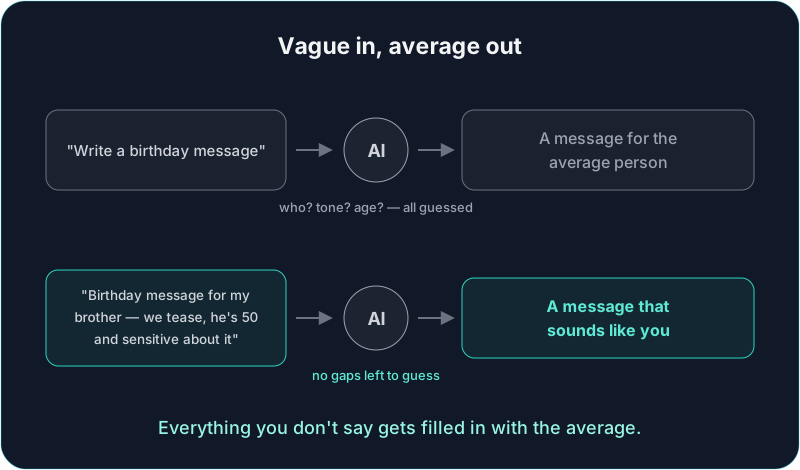
Everything you don't say, the AI fills in with the most average assumption.
Ask it to "write a birthday message" and it has to guess who the birthday person is, how you know them, and how you talk. So it guesses the average of all of it — and you get a message for the average person, from the average person, in the average voice. Technically correct. Fits nobody.
Nothing went wrong there. The machine did exactly its job: it guessed. Every detail you do give it replaces a guess — "birthday message for my brother, we tease each other constantly, he just turned 50 and is weirdly sensitive about it" pulls the answer away from the average and toward your situation. That single idea is the whole game. The habits below are just five ways to apply it.
Why "make this better" doesn't work
The most common ask in the world is some version of "make this better." And it is genuinely hard for the AI — not because the request is too small, but because "better" is not a direction. Better how? Shorter or more detailed? Warmer or more professional? Funnier or more serious? Each of those is "better" to somebody.
So the AI does the only thing it can: it guesses the average meaning of "better" — usually a bit longer, a bit more formal, a bit more polished. Which is exactly what you did not want, or you would not have asked.
You do not have this problem with people, because people ask follow-up questions. Tell a friend "make this better" and they say, "better how? What's it for?" The AI, by default, just answers. So the habit is simple: answer the "better how?" question before it gets asked.
The five habits
1. Say what "good" looks like
Name the goal and the constraint, not just the wish. "Make this shorter" is a wish. "I need this under 100 words without losing the apology" is a target the AI can actually aim at — and just as important, one you can check the answer against.
2. Hand over the real thing
Do not describe the letter — paste the letter. Do not summarize the recipe from memory — paste the recipe. Every detail you paraphrase away is a gap the AI will fill with an average guess. As Part 2 covered: it can take a lot of text, and photos and documents too. The real thing is always a better brief than your summary of it.
3. Give the context a stranger would need
The confident stranger at the party from Part 1 has read everything in general and knows nothing about you. So tell it what it cannot know: who the answer is for, what the situation is, what is off the table. "Dinner ideas" gets you the internet's average dinner. "Dinner for four, one vegetarian, thirty minutes, and the kids revolt at anything spicy" gets you your dinner.
4. Show an example when you have one
If you have ever brought a photo to a hairdresser instead of trying to describe a haircut, you already know this habit. "Here's a thank-you note I wrote that sounds like me — write this new one in the same style" beats any number of adjectives about your style. Examples carry the details you would never think to put into words.
5. Don't aim for a perfect first ask
This is the habit that saves you from the other four becoming homework. You do not need to brief perfectly up front, because — as Part 2 said — it is a conversation, not a slot machine. Ask, look at what comes back, and steer: "shorter," "less formal," "you dropped the thank-you, put it back." Each correction is just specificity arriving late, and that is fine.
And here is the trick almost nobody tells beginners: you can make the AI do this work for you. Add one line to any ask — "Before you answer, ask me anything you need to know to do this well" — and it will interview you for the details it is otherwise going to guess.
Watch one ask get better
Here is all of it on one real chore: replying to an email you have been avoiding. Say your kid's coach emailed asking you to run the team fundraiser this year, and you need to decline.
Ask 1 — the wish:
Make this email better.
The AI guesses what "better" means: the reply comes back longer, stiffer, and vaguely corporate. Fits nobody, least of all you.
Ask 2 — add the goal:
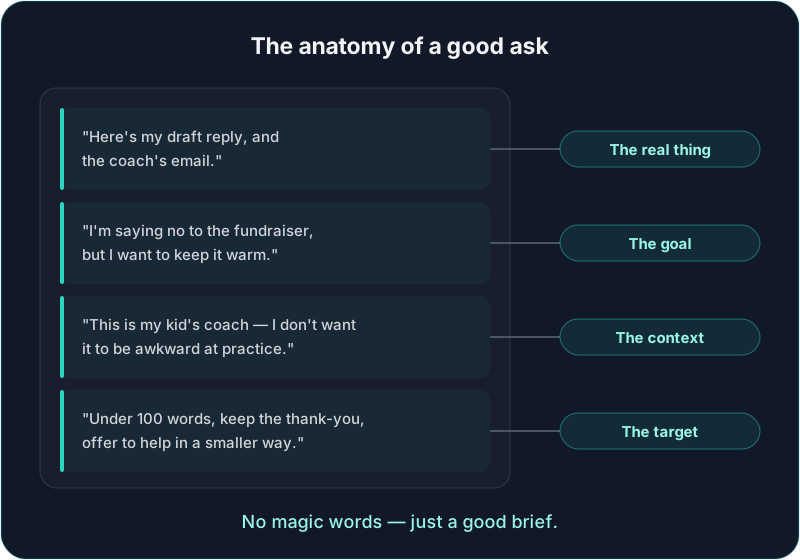
Here's my draft reply. I'm saying no to running the fundraiser, but I want to keep it warm — this is my kid's coach and I don't want it to be awkward at practice.
Now the answer has a direction: a warm, clear no. Already ten times more useful.
Ask 3 — add the constraints:
Here's my draft reply, and the coach's email. I'm saying no to running the fundraiser, but I want to keep it warm — this is my kid's coach and I don't want it to be awkward at practice. Keep it under 100 words, keep the part where I thank her for coaching, and offer to help in a smaller way instead.
That answer you can send with one read-through. Notice what changed between the asks: not magic words — just the goal, the raw material, the audience, and what "good" looks like. That is the whole anatomy of a good ask.
What a good ask cannot fix
Three honest limits, so this stays trustworthy:
- A perfect ask cannot fix made-up facts. Briefing well makes answers fit better; it does not make them true. The confident-stranger rule from Part 1 applies to the best-briefed answer exactly as much as the laziest one. Why AI makes things up — and what to do about it — is the next part of this series.
- More words is not the goal. A long rambling ask is not a specific ask. One relevant detail — who it's for, what it's for, what must not change — beats three paragraphs of throat-clearing.
- Nobody is grading you. These are habits, not rules, and the cost of a weak ask is trivial: you look at the answer and ask again. You will pick these up by using them, not by studying them. (If you ever see the term "prompt engineering" in the wild, this is all it means — asking well. You now know the useful parts.)
Next in the series: when AI makes things up — why a confident answer is not the same as a correct one, and why you can ask the same question twice and get two different answers. The series overview has the full roadmap.
Ethyx is in closed testing with an access code today. Everything in this post applies to any AI chat app, not just ours.
You do not need Ethyx — or any particular product — for this series to be useful.