
AI 101 · Part 2 of 7
August 27, 2026 · 7 min read
By David Crush
What should you actually use AI for?
In Part 1 we covered what AI actually is: a very good guesser, like the pooled guess of an enormous crowd. The natural next question is: fine — but what do I actually do with it?
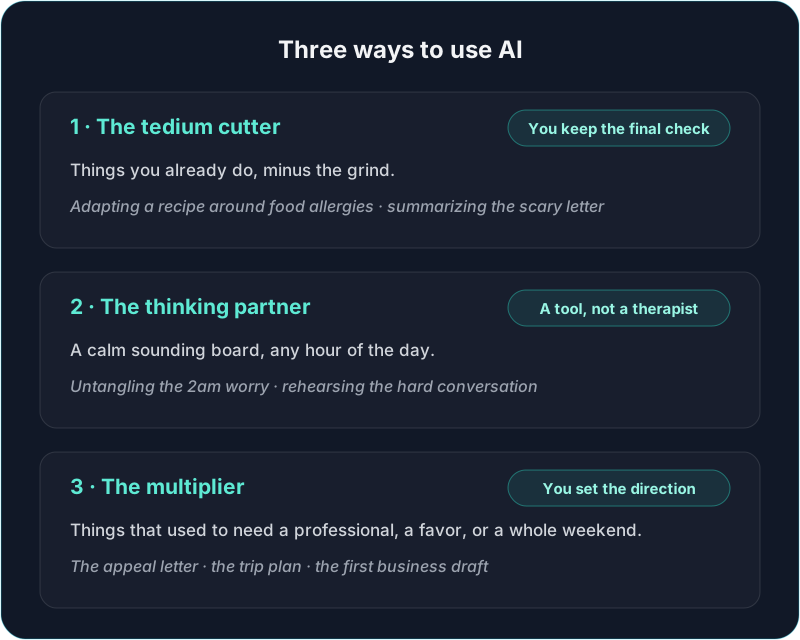
There are thousands of answers, and that is exactly the problem. A list of thirty use cases is overwhelming and forgettable. So instead, here are three ways to think about it — three buckets you can sort any future idea into — with real examples from our own house.
Two things nobody tells beginners
First, the mechanics. Using an AI is like texting: you type or paste into a chat box and send. Paste in a whole recipe, a confusing letter, an email thread — it can be long, that is fine. Most apps also let you attach a photo or a document: snap a picture of the recipe card, attach the PDF. If you can text, you have all the skills required.
Second, the reassurance. You cannot break it. Asking again costs you nothing meaningful, no question is too basic, and nobody is watching you fumble. Most importantly: it is a conversation, not a slot machine. If the answer misses, just say so — "shorter," "simpler," "no, I meant the other kind" — and it tries again. People who get real value from AI are not better at asking the first time; they are just comfortable pushing back.
Bucket 1: The tedium cutter
Things you already do, minus the grind.
Here is a real one from our house. My wife and I both have food allergies. Every new recipe used to mean cross-referencing every single ingredient against two different allergy lists — tedious enough that we often just didn't bother with new recipes at all. Now we paste the recipe into an AI first:
Here's a recipe. I'm allergic to X and she's allergic to Y. Can you adapt it to be safe for both of us, suggest substitutions, and flag any ingredients that commonly hide either allergen?
It swaps ingredients, suggests substitutions we would not have thought of, and flags the sneaky places allergens hide.
Now the honest part, because it matters: this does not replace reading labels and ingredient lists. We still check everything before it goes in the cart — with allergies, the final check is non-negotiable. What the AI removes is the tedium: instead of researching every little item from scratch, we verify a short, focused list. The AI narrows the work; we keep the final say.
Same bucket, different chore: summarizing. The scary three-page insurance letter, the 40-message email thread you got added to late, the dense school newsletter with one date you actually need. Paste it in and ask: "Summarize this in plain language. What do I actually need to do, and by when?" Then spot-check the parts that matter before acting — the pattern is always the same. AI compresses; you confirm.
Bucket 2: The thinking partner
A calm sounding board, any hour of the day.
This one is more personal, and we suspect more common than people admit: we use AI to help keep our anxieties in check. The 2am worry that keeps circling. The to-do list that has stopped being a list and become a wall. The hard conversation you keep rehearsing in the shower.
Writing the worry down and asking something like:
I'm anxious about this and I can't tell how serious it actually is. Can you help me sort out what's realistic to worry about here, and what the actual next step would be?
does something useful: it makes you articulate the worry, and it answers back calmly, at 2am, without judgment and without getting tired of you. Often the answer matters less than the untangling.
Two honest boundaries. This is a tool for organizing your thoughts — it is not therapy, and it is not a crisis resource. A worry spiral that will not break, or real distress, deserves real humans: someone you trust, or a professional. An AI is a sounding board, not a lifeline. And if you are wondering who can see what you type at 2am — good instinct. What happens to what you type gets its own part later in this series.
Bucket 3: The multiplier
Things that used to need a professional, a favor, or a whole weekend.
The first two buckets make existing tasks easier. This bucket is different: it is the things you simply did not do before, because they cost too much — in money, time, or knowing-somebody.
Start small. A formal appeal letter when your insurance claim is denied. Making sense of the denial letter itself. A multi-stop trip itinerary that accounts for everyone's constraints. A first real household budget:
I want to appeal this insurance denial. Here's the denial letter and what actually happened. Can you draft a formal appeal letter, and tell me what documentation I should attach?
Ten years ago, that meant paying someone, asking a favor from the one friend who "knows about this stuff," or giving up a weekend to learn it yourself. Most people gave up the weekend — or just gave up.
And it scales up from there. It has genuinely never been easier or cheaper to start something. A business plan, marketing copy, market research, a first draft of everything — work that used to need money or a small team, one person can now draft in an afternoon. Not because AI replaced the team, but because of something subtler: AI lets one person's knowledge go further. Instead of an expert spending weeks teaching ten people how to do a task, the expert explains it once, precisely, to the AI — and the work happens at a fraction of the time and cost. The scarce ingredient stops being hands and starts being clear direction.
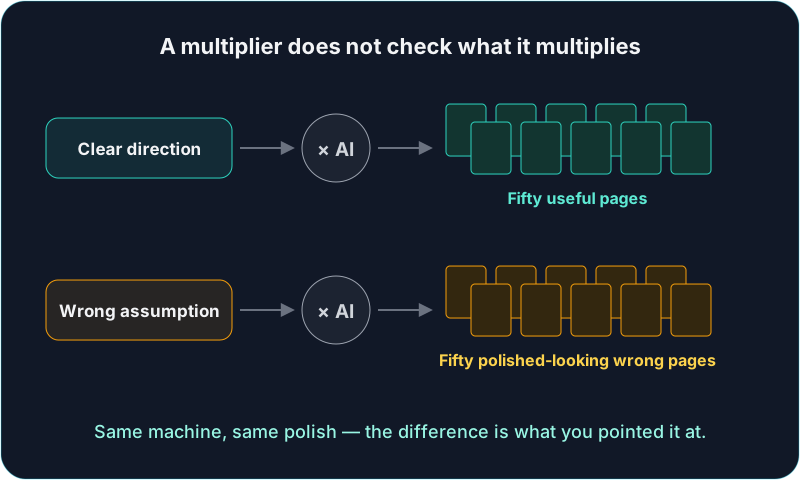
Which is the honest rule for this whole bucket: AI is not a replacement for people — it is a multiplier of a person. It executes; it does not decide. It does not know what you are trying to build, what your customer needs, or what "good" looks like to you unless you tell it. The clearer your direction and judgment, the more it multiplies. Without human leadership, it will confidently multiply nothing in particular.
And one cautionary tale, because multipliers do not check what they multiply. Point one at a wrong assumption, a bad plan, or a misunderstanding, and it scales that just as cheerfully — a mistake that used to stay in one draft can be fifty polished-looking pages by lunch. That is exactly why understanding how AI works and where it fails — the point of this series — is not optional homework. It is what keeps the multiplier pointed at good.
The thread through all three
Notice what never changed across the buckets: you stayed the leader. The AI cut the tedium, but you read the labels. It untangled the worry, but you decided what to do about it. It drafted the plan, but you set the direction and judged the result.
The rule from Part 1 — treat AI answers like advice from a confident stranger at a party — applies in every bucket, and it matters most in the multiplier bucket, because that is where mistakes scale too.
One more thing you may have noticed by now: ask the same question twice and you rarely get the same answer twice. That is normal — it is part of how a guesser works — and a later part of this series explains when it matters.
Next in the series: how to ask so you get good answers — no magic words, just a few habits that make a big difference. The series overview has the full roadmap.
Ethyx is in closed testing with an access code today. Everything in this post applies to any AI chat app, not just ours.
You do not need Ethyx — or any particular product — for this series to be useful.